Claude Skills & Plugins: What They Are and Whether You Should Care
The short version: Claude Skills turn reusable workflows ("make me a REST client", "run a full spec-driven build") into shareable packages — with optional code inside, not just prompts. HN has argued about them for ten months: heavy Claude Code users call them a genuine productivity lever; skeptics say they're just neatly packaged CLAUDE.md files and one more way to get locked in. If you live in Claude Code daily, learn them. If you touch it occasionally, don't bother yet.
What exactly are Claude Skills?
Anthropic describes a Skill as a folder with a SKILL.md file (instructions) plus optional code, scripts, and assets. When the skill is referenced, Claude loads it into context — so you stop re-explaining your workflow every session. The HN crowd put it more memorably:
"Besides a reference manual, Claude Skills is analogous to a toolkit with an instruction manual — it includes both instructions (manuals) and executable functions (tools/code)."
It sits on top of Claude Code, alongside commands, MCP and subagents. One commenter neatly drew the map:
"Plugins include: Commands, MCPs, Subagents, and now, Skills. Marketplaces aggregate plugins."
What users actually praise
Across three big HN threads the praise converges on two things: standardization and reuse. People were already hand-rolling markdown guides in CLAUDE.md — Skills formalize that, and formalization has a real return:
"That's exactly what it is — formalizing and creating a standard induces efficiency. Along with things like AGENTS.md, it's all about standardization."
The other repeated win: it fixes CLAUDE.md bloat. Huge codebases make CLAUDE.md a dumping ground that pollutes every context window:
"A problem with huge codebases is that CLAUDE.md files become bloated with niche workflows like CI and E2E testing. Combined with MCPs, this pollutes the context window."
And the sharing economy is real: developers publish skills for DOM manipulation, Godot games, geospatial pipelines, Kindle export recovery — a 337-point Show HN shipped complete Godot games built from a skill.
What users are skeptical about
This is the part the marketing won't tell you.
1. "It's CLAUDE.md with makeup." The most common objection, from the very first thread:
"For Claude Code, this seems to have generous overlap with existing practice of having markdown guides listed for access in the CLAUDE.md. Maybe skills can simply make managing such guides better."
— bicx, HN
"Yeah my first thought was, oh it sounds like a bunch of CLAUDE.md's under the surface :P"
2. Ecosystem fatigue. Skills landed right as plugins, marketplaces, connectors and agents all multiplied:
"Getting hard to keep up with skills, plugins, marketplaces, connectors, add-ons, yada yada."
3. Lock-in fear. Several commenters see provider-specific formats as the point, not the side effect:
"It's a big downside as a user to have more and more of these provider-specific features. More to learn, more to configure, more to get locked into. Of course this is why the model providers keep pushing them."
4. Quality control. Anyone can publish to the community market. The official directory is Anthropic-curated, but stars ≠ quality, and nobody has a rating system yet.
Skills vs CLAUDE.md vs MCP
The honest summary from the threads: CLAUDE.md is your project's memory, Skills are reusable packages, MCP is a protocol for tools. They overlap more than Anthropic's docs would like you to think — one commenter points out Skills look a lot like MCP prompts — but they solve different problems:
"MCP is a protocol, a proposal on standardizing how to do things so we can reuse tools. Whatever thing you want to do with MCP you can do without MCP. But when lots of people agree to a standard, the ecosystem compounds."
A second HN thread was literally titled "Claude Skills are awesome, maybe a bigger deal than MCP" (738 points). That's the bull case. The bear case is the lock-in argument above.
How to start (the boring, correct way)
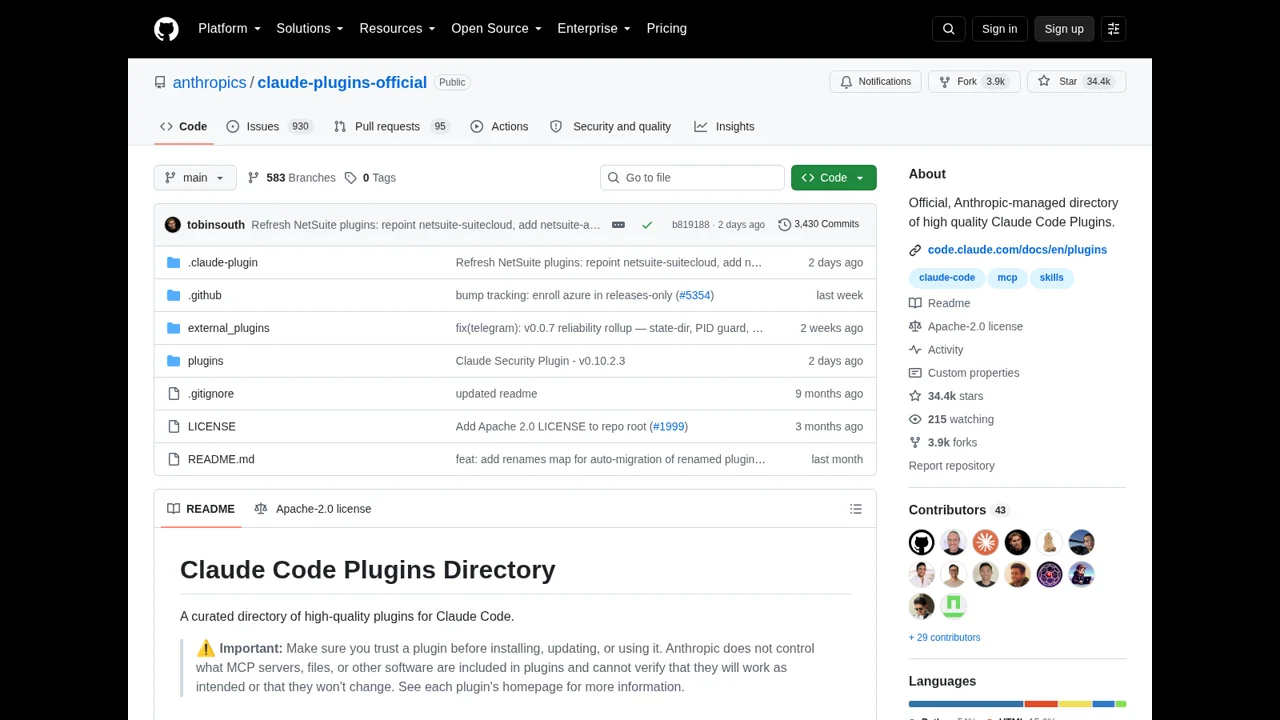
- 1Don't mass-install. Browse the official directory first (anthropics/claude-plugins-official) — 34k stars, Anthropic-curated.
- 2Try one skill related to your actual workflow (REST clients, testing, docs). Read its SKILL.md — if it's just a one-page markdown, you're not missing anything.
- 3Learn by writing one — a skill is a folder with an SKILL.md. Convert one thing you re-explain to Claude every week. That's the whole game, and it's where the reuse payoff actually comes from.
- 4Ignore the community market until you know you need one — quality is unvetted; the official directory plus your own will cover 90% of needs.
The honest verdict
Use Skills if:
You're in Claude Code most days and keep re-teaching it the same workflows. Skills (or a small set of them) will cut that. The standardization argument is real — the ecosystem is compounding around community-made skills.
Skip them if:
You use Claude (or Claude Code) occasionally, or you already keep a tight CLAUDE.md and your workflows are simple. The overlap with plain markdown guidance is real enough that you're not losing much. Revisit when your own CLAUDE.md starts getting bloated — that's the trigger.
One honest caveat:
The lock-in complaints are valid. Everything here is Anthropic-shaped. If you care about portability, treat skills as an experiment, not an investment. Community pressure (like AGENTS.md becoming a cross-tool standard) may pull it open later — or not.
Browse the official directory →
Method: 913 comments read across the three largest Hacker News threads on Claude Skills (816p / 738p / 337p, October 2025 – August 2026), categorized on 2026-08-27. Repository stars and dates pulled live from the GitHub API the same day. Quotes are verbatim with links. We don't take payments from vendors — this site survives on being useful.