Cursor alternatives after the SpaceX deal: what 545 developers actually said
OpenAI has given Cursor a written eviction notice and a date: November 12, 2026. We read all 545 comments on the thread, then checked today's prices on every alternative people named. The short version: most Cursor users aren't affected, because most of them never used OpenAI models in it — and the ones who did have a cheaper answer than another editor subscription.
The short version
- The trigger is contractual, not technical. OpenAI says it can't be confident SpaceX will honor its terms of service, and cited a change-of-control clause plus two past incidents involving Musk companies.
- Your editor is a reseller relationship. Buying Cursor was always buying a bundle of other companies' models at a markup. OpenAI just demonstrated the bundle can shrink on seven weeks' notice.
- If you used GPT models in Cursor: switch to OpenAI's own CLI rather than another editor. You're already paying for the models; the middleman is the part that broke.
- If you used Composer or Grok in Cursor: the honest answer from the thread is that this changes nothing for you, and $20/month is still the cheapest way to get those models with generous limits.
- Diary date: November 12, 2026. Also worth knowing — Windsurf, the other half of the 2025 "Cursor or Windsurf?" question, no longer has a pricing page of its own.
Three dates are the whole story
June 16: SpaceX agreed to buy Anysphere, the company behind Cursor, for $60 billion in stock — an option it had floated in April, when the alternative was paying $10 billion for a partnership. Reuters reported the all-stock structure, a $10 billion termination fee ($4 billion if antitrust blocked it), and the strategic logic: Cursor's data on what developers ask for would help train SpaceX's models, not the other way around.
August 14: the deal closed. Investing.com's read of the 8-K put it at roughly 389 million shares to Cursor's holders and called it the largest startup acquisition on record; Cursor became a wholly owned subsidiary inside a division now branded SpaceXAI, with access to the Colossus supercomputer and a beta of something called Grok Bot. Analysts quoted in the same piece expect the Cursor name to fade in favor of Grok. Cursor's own pricing page has already moved that way: the feature lists advertise "generous limits for Grok" and "Grok Bot access" — no third-party model names at all.
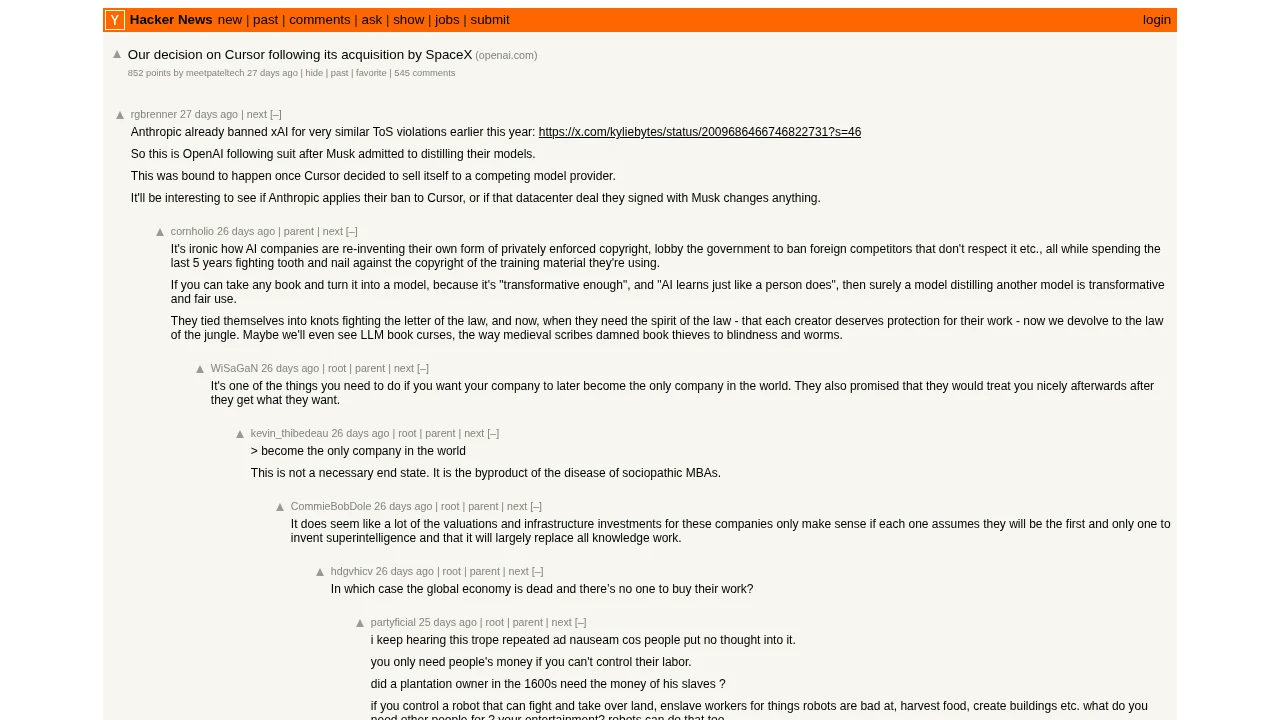
August 28: OpenAI published a post titled "Our decision on Cursor following its acquisition by SpaceX." This is the part worth reading in the original, because the reasoning is unusually blunt. It notifies SpaceX that OpenAI intends to wind down the contract supplying models to Cursor, "with a proposed shutoff date of November 12, 2026," and it gives the maximum notice the contract allows. The stated reason:
"We are making this choice because we cannot be confident that SpaceX will use our technology within our terms of service, based on our experience with Elon Musk's companies violating contracts."
OpenAI, Our decision on Cursor following its acquisition by SpaceX
The post links two supporting incidents: a 2023 New York Times report that the company then called Twitter broke the terms of its OpenAI contract, and Musk's admission under oath earlier this year that xAI — now part of SpaceX — trained on distilled OpenAI data. It also names the model that made the calculus urgent: Astra, whose release OpenAI says needs a "new level of accountability" about how it is used. Existing models keep working until the November date. New ones were never going to arrive.
The question the thread asked second, and should have asked first
Most of the 545 comments argued about which company is the bad actor. The genuinely useful comments asked a duller question: which model do you actually use? They produce very different answers to "should I leave Cursor."
The most-replied comment in the thread, from redox99, framed it as a business model that was always on borrowed time: "Cursor's business model of reselling others' APIs had its days numbered... Cursor is already kind of useless for third party models unless you're willing to spend thousands of dollars. It's only worth it if you're going to use mostly grok/composer."
charrondev is the profile of the user this doesn't touch: "I used cursor extensively both at work and for personal use. Its harness is pretty darn good but I basically never used OpenAI models in it." Their reason was economics — the first-party models have "very generous usage limits included in the base plans."
And bentt, who pays for Cursor and Claude but not OpenAI, is the profile it does: "this will push me back to Anthropic." Later in the same thread they gave the more honest version of switching: "I've been a Cursor subscriber for a while and it was just momentum."
The sharpest piece of advice in the whole thread came from ralusek, three words long: "Using OpenAI through codex (cli) is the way you should use it." If GPT models are what you were buying, an editor that resells them is a worse deal than the vendor's own tool. nab says their team rebuilt around exactly that idea — sitting on top of "the model harnesses (Codex + Claude Code), so you can bring your own subscriptions."
Where people said they were going, and what it costs today
Prices below were pulled from the vendors' own pages on September 26, 2026, not from memory. Where we couldn't get a number we say so instead of guessing.
| Option | Cost today | Fits you if |
|---|---|---|
| Stay on Cursor cursor.com/pricing |
Hobby free; Individual $20/mo (Pro / Pro+ / Ultra); Teams $40 per user/mo; Enterprise custom | You use Composer and Grok and rarely touch third-party models |
| Codex CLI OpenAI's own agent |
We won't quote a number — OpenAI's pricing pages need JavaScript to render and we couldn't read a price today. It's sold as part of ChatGPT's paid plans | GPT is the model you were paying Cursor for |
| Claude Code claude.com/pricing |
Pro $17/mo billed annually ($200 up front) or $20 monthly, includes Claude Code; Max from $100/mo; Team seats $20/seat/mo annual | You want Anthropic's models directly instead of through a reseller |
| Devin / ex-Windsurf devin.ai |
Free tier; Pro $20/mo; Max $200/mo; Teams $80/mo plus $40/mo per full dev seat. Model list now includes "frontier models from OpenAI, Claude, Gemini, and SpaceXAI" | You want a mix of vendors in one subscription and don't mind another reseller |
| OpenCode opencode.ai |
Open source, no licence fee; you bring an API key (the Zen gateway is optional) | You'd rather own the harness than rent it |
| Void / Cline and friends | Free, your key, your bill | You want to be impossible to cut off |
One detail worth flagging on that table: the option marked "ex-Windsurf" is the second half of the 2025 question this site has been asked about most. We crawled windsurf.com/pricing while writing this and got Devin's pricing page — the Windsurf brand doesn't appear in it. The comparison everybody wrote last year has quietly become a comparison of a product against its own acquirer.
The structural point, which has nothing to do with Musk or Altman
Strip out the personalities and the thread contains a genuinely useful warning about how AI tools are priced. Resellers sell subsidized access to someone else's models. That is a great deal for buyers while it lasts and a fragile one by construction: the moment your vendor and their supplier disagree about anything — money, terms, a change of ownership — the bundle you subscribed to can be renegotiated without your involvement. Eridrus made the counter-argument that subscriptions create useful lock-in for both sides, and landl0rd pointed out the boring reason vendors prefer them: predictable revenue is easier to forecast and borrow against. Both are true. Neither changes what happens to your editor in November.
The practical hedge is the one several commenters had already built for themselves: keep the harness and the model separate. verdverm uses OpenCode — "a great harness for the time being, still has gaps" — while being upfront that they're "not keen on OpenCode long term"; the reason they gave was the project's own conduct, not its code. That's the honest state of this market: the tools are good, the vendors are all volatile, so you pick the layer you can replace cheaply.
Our read: move or stay
Who should act, and who shouldn't
- Act (if you were paying Cursor for GPT): move to Codex CLI or the harness you already trust, and cancel the Cursor seat if GPT-on-Cursor was the only reason you had it. You're currently paying a markup for access with a hard expiry date.
- Act (if you were paying Cursor for Anthropic models): price the direct subscription first. $17–20/month for Claude Code with no reseller in between is hard to argue with.
- Don't act (if you use Composer or Grok): the thread's consensus is that these are the cheap, high-limit models and nothing about them changed. Switching editors to make a political point is choosing pain for no gain.
- Don't act on the news cycle: the shutdown date is November 12, not today, and every vendor in this table has changed its shape at least once in the last twelve months. Wait for the price to change before you change your workflow.
- One thing to check before the date: if you run a team, find out which people rely on GPT models inside a reseller's editor. That's a seven-week migration, not a same-day outage — but only if you know who they are.