Ollama vs LM Studio in 2026: Same Price Ladder, Two Different Bets
The short version: the two biggest local-LLM apps have converged. Both are free to run models on your own machine, and both now sell a $20/mo and a $100/mo cloud tier. So the question is no longer "which is better" — it is which layer you want to depend on: LM Studio’s app plus its new agent (Bionic), or Ollama’s pull-and-serve CLI. If your only metric is tokens per second on a Mac, the honest answer is neither: an HN benchmark in the same Gemma 4 thread measured llama.cpp’s Metal backend at ~40 tok/s generation where an MLX server returned 5–13 tok/s on matched 4-bit quants of the same model.
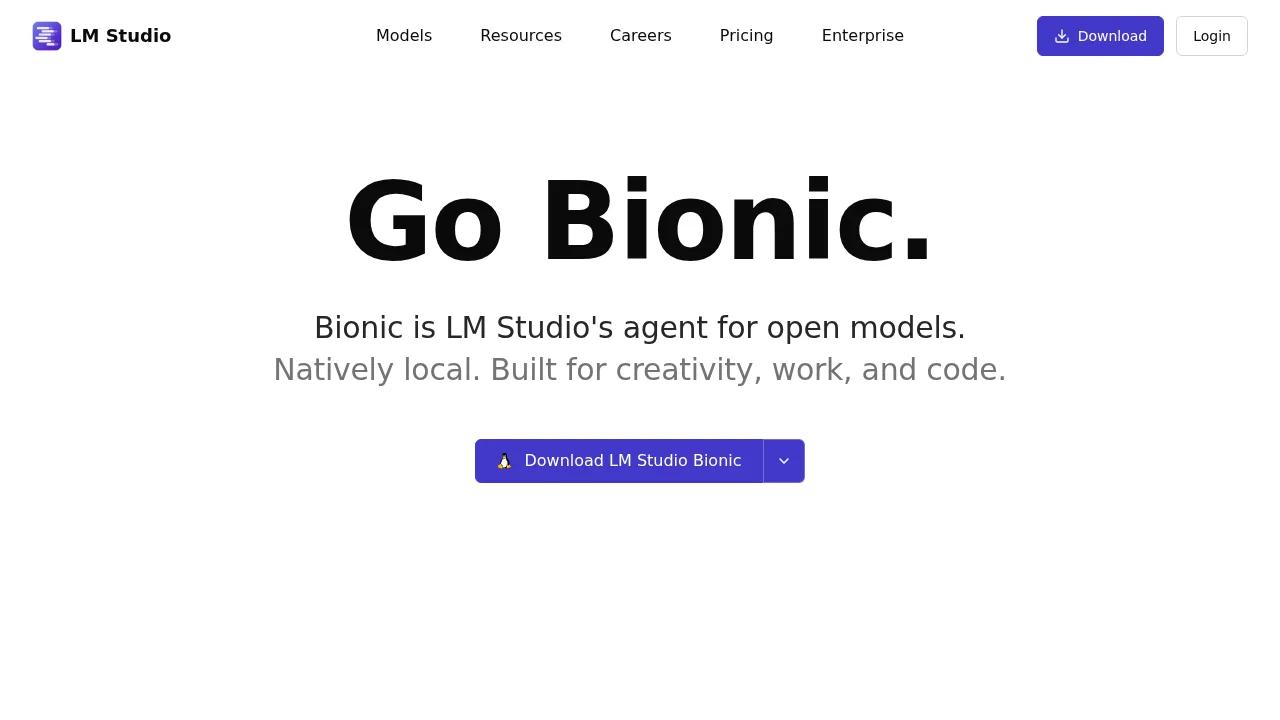
LM Studio’s homepage today: Bionic is the product, local models are the pitch, cloud credits are the business. Screenshot 2026-09-22.
The price ladder is identical now (both checked 2026-09-22)
This is the part almost every comparison page gets wrong, because it changed: neither of these is a free tool with a donate button anymore. They are subscriptions with a free local tier as the on-ramp.
| Tier | Ollama | LM Studio |
|---|---|---|
| Free — $0 | Run models locally, starter usage credits, pay-as-you-go, no service fees | Bionic agent, llama.cpp + MLX runtime, offline voice transcription, LM Link for up to 5 devices, limited web search |
| Mid — $20/mo | Pro — $60 of usage credits/mo, access to larger pro models, run multiple models concurrently ($16.67/mo billed annually) | Bionic+ — US-hosted open-source models (Kimi K3, GLM 5.3, DeepSeek V4 Flash), web search + page extraction, bulk token discounts |
| Top self-serve — $100/mo | Max — $300 of credits/mo, early access to new models, 10 concurrent requests | Pro — 5× usage limits, early access to new features |
| Team | Team $500/mo (early access) — unlimited users, $1,000 shared credits, centralized billing. Enterprise: custom | Centralized billing “for your team” — the pricing page stops there |
What actually differs: which layer each company owns
Ollama owns the packaging layer: a CLI and a server with a Docker-ish registry model, so ollama pull plus hot-swapping has been the reason people stay. An HN user running a Discord bot with different models per feature put it plainly:
“The biggest advantage for me with ollama is the ability to ‘hotswap’ models with different utility instead of restarting the server with different models combined with the simple ‘ollama pull model’.”
LM Studio owns the application layer: a GUI, and since 2026 an agent harness called Bionic that runs on your machine, writes documents, and now ships skills, session introspection and command review (their blog has posts through September 2026). The catch is the same one users raised on launch day: the app is the product, and the agent layer is not open source.
“As far as i see this is not open source but has the tag line ‘Meet LM Studio Bionic, the AI agent made for open models’ … the agent and harness layer being open is probably more important than your models as you can just switch models every week and they are commodity.”
Underneath both of them sits the same thing, and this is where the arguments get sharp: llama.cpp / GGML, maintained by a different group of people.
The 1,445-line argument (and why a business should care)
April 2026, 648 points: “The local LLM ecosystem doesn’t need Ollama”. The criticism was not that Ollama is bad software. It was about credit and claims. One commenter reconstructed the timeline from Ollama’s own repo history — its v0.0.1 README described itself as an inference server “powered by llama.cpp”:
“If your public product is, from day one, a packaging / UX / distribution layer on top of upstream work, then conspicuous credit is not optional. It is part of the bargain. ‘We made this easier for normal users’ is a perfectly legitimate contribution. But presenting that contribution in a way that minimizes the upstream engine is exactly what annoys people.”
In the earlier Ollama Turbo thread (430 points), a commenter counted the actual divergence between the two codebases — ±1,445 lines out of ~175k — and then made the point that matters if you are choosing infrastructure:
“The sense I get from some of your communications is ‘what’s the boldest, strongest claim we can make that’s still mostly technically true’. As a potential user, taking those claims as true until closer evaluation reveals the discrepancy feels pretty bad, and keeps me firmly in the ‘potential’ camp.”
Not everyone is hostile. Another commenter framed it as the standard open-source trap: take VC money, and the enterprise tier becomes the only exit. Threads like this are why the “OSS” label on a runtime deserves a second look before it goes into a product.
What people who run both actually report
- “llama-server does it too.” — “now llama-server implements an OpenAI compatible API and you can also connect to it with any Web browser … it should have eliminated the last Ollama advantage.” (adrian_b, HN)
- What does the wrapper add? — “There’s now a ChatGPT style interface baked into llama.cpp … (I’m not entirely sure what Ollama would get me that llama.cpp doesn’t, happy to hear suggestions!)” (troad, HN, M4 MacBook Pro)
- The speed reality check — on an M4 Max with 48GB, the recommended coding model took “anywhere between 6-25 seconds for a response … from me asking ‘Hello world’” (domh, HN)
- MLX is not automatically faster — matched 4-bit quants of Gemma 4 26B-A4B on an M1 Max 64GB: llama.cpp Metal ~395 tok/s prompt, ~40 tok/s generation; the MLX server ~350 tok/s prompt, 5–13 tok/s generation — “3–7× slower … counter-intuitive given MLX is Apple’s native ML framework.” (d4rkp4ttern, HN)
- The agent first-run — “I use Codex as my main agent, and the UI looks similar enough that it’s familiar … I just pointed it to my existing LM Studio models library, ran Qwen3.6 35B, and the results are exactly what I would hope for.” — followed by five specific rough edges: no visible working directory, no pre-load, no unload button, “Working” instead of “Loading model”, and an agent that created its own folder next to the one it was pointed at. (inventor7777, HN)
One detail worth noticing from that Bionic thread: the founder showed up offering free cloud credits to anyone who emailed their username (yags, HN). Free local models are the funnel. The $20 and $100 tiers are the product.
The honest verdict
Pick LM Studio if:
You want a GUI plus an agent that works on documents and code with open models, you use two to five machines (LM Link), and you accept a closed-source agent layer. Budget for rough edges — it is a young agent — and treat the cloud tier as the thing they are actually selling you.
Pick Ollama if:
You live in a terminal, script against an API, and want one server pulling and hot-swapping several models. The free tier with local models plus credits is genuinely usable; the Pro tier only makes sense if you are also buying cloud model access.
Pick neither (use llama.cpp directly) if:
Throughput is the point, you are on Apple Silicon, or you refuse to depend on a wrapper. llama-server speaks the OpenAI API, has a built-in web UI and router support now, and the benchmark above is the reason people keep saying this.
Skip both entirely if:
Your workload is agentic coding with 100k-token contexts. The recurring HN conclusion is that local models are “good enough for X” — private, stable, controllable — not a replacement for frontier models. We covered that trade in local LLM vs API.
Local LLM vs API → Free coding assistants → Free LLM APIs →
Method: pricing read directly from ollama.com/pricing and lmstudio.ai/pricing on 2026-09-22; quotes verbatim from HN threads on Ollama’s MLX preview (648 pts, Mar 2026), “the local LLM ecosystem doesn’t need Ollama” (648 pts, Apr 2026), Running Gemma 4 with LM Studio’s headless CLI (407 pts, Apr 2026), LM Studio Bionic (331 pts, Jul 2026) and LM Studio 0.4 (239 pts, Jan 2026). We don’t take payments from vendors.