Copilot Credits: the $0.01 meter Microsoft just put under Copilot
On September 25 Microsoft relaunched Copilot around three things — Home, Code and Autopilot — and in the same post said the new agentic capabilities "all run on UBB". UBB is usage-based billing. Its unit is the Copilot Credit: $0.01 each, pooled at the tenant level. The short version: your seat price is now an entry fee rather than a bill, individual users should stop paying, and if you run a team you should set a spending cap before anyone switches an agent on.
The short version
- What changed: Microsoft 365 Copilot was renamed Microsoft Copilot in August (it is in the change log of Microsoft's own credits guide), and the September relaunch turned it from a chat app into three surfaces: Home, Code (built on the same technology as GitHub Copilot) and Autopilot, which is the agent formerly known as Scout, hosted in your tenant with its own identity in the directory.
- Where the money moved: the new agentic work runs on credits. Microsoft's September 2026 guide prices the pay-as-you-go meter at $0.01 per Copilot Credit, and states plainly that Work IQ APIs "are not included as entitlements in the Microsoft Copilot licence".
- The catch for whoever signs the invoice: credits pool across the whole tenant, so one team's runaway agent spends everyone's budget, and Microsoft's own per-task figures are labelled "rough planning estimates". There is no per-task price list to plan against.
- For individuals: don't buy. The consumer side is what Microsoft is backing away from, and the AI-free version of its consumer subscription exists but is hidden behind the cancellation flow — which is the behaviour behind a live consumer-protection case in Australia.
- Diary dates: November 2, 2026, when usage-based billing becomes the default for new Copilot Business licences bought through Microsoft's partner channel; and December 31, 2026, when the $18 promotional year ends and the list price of $21 comes back.
What Microsoft actually shipped
The company's own announcement on September 25 is worth reading before the angry summaries. Copilot now has three named capabilities. Home is where chat, Cowork and, new this week, full Word, Excel and PowerPoint sessions live. Code is a sandboxed builder for people who are not developers, running on the same underlying technology as GitHub Copilot and hosting its output inside your tenant through something called Microsoft Copilot Managed Runtime, which is in preview. Autopilot is the agent previously called Scout: cloud-hosted, with its own identity, memory, computer and workspace, working on objectives you set while you are asleep.
Reuters framed the launch as Microsoft turning Copilot into "a one-stop shop for office workers" and quoted Annie Pearl, corporate vice president of Copilot Product, on the reason for the emphasis: "I think it's been very hard for many organizations to bring agents into the enterprise because of security, compliance and governance concerns." That is the enterprise pitch, and it is honest about who the product is for. The consumer pitch is going the other way: the Hacker News submission of Bloomberg's story used the headline "Microsoft abandons personal AI chatbot race with Copilot reboot" (143 points), and by September 26 Windows Central was reporting that the Copilot+ PC branding — the badge, the button, the NPU spec — is being pulled back by Microsoft and its PC makers.
Put those two stories side by side and the strategy is legible. Conversations were never the product. Work is the product, and work is now metered.
The meter, in Microsoft's own numbers
Everything below comes from the Copilot Credits Guide dated September 2026, from Microsoft's pricing page, or from its partner channel documentation, all read today. Nothing here is a leak or an estimate of ours.
| Item | Number | Source |
|---|---|---|
| Copilot Credit, pay-as-you-go | $0.01 per credit, billed in arrears at the end of the billing month | Copilot Credits Guide, Sept 2026 |
| Work IQ Tools API call | 0.1 Copilot Credit (about $0.001) per API call for actions and tools; query-style calls are variable | same |
| Copilot Credit pre-purchase (P3) | One-year pool, paid up front, discounts by tier: 300,000 credits −5%, 1.5M −6%, 3M −7%, 15M −8%, 30M −10%, 75M −12%, 150M −14%, 225M −17%, 300M −20% | same |
| What consumes credits | Cowork, Code, Autopilot, frontier models named Astra and Fable, Work IQ API calls, Copilot Studio agents built on the GitHub Copilot harness, and AI in Dynamics 365 and Power Platform | Microsoft blog, Sept 25 + credits guide |
| What the seat still covers | Copilot Chat in Microsoft 365, Copilot inside Word/Excel/PowerPoint/OneNote/Outlook/Teams, the built-in Researcher, Analyst and Facilitator agents, and Work IQ grounding | credits guide, "our commitment" section |
| What the seat explicitly does not cover | Work IQ APIs: "not included as entitlements in the Microsoft Copilot licence" | same |
| Copilot Business seat | $18/user/month billed yearly (list $21) or $25.20 billed monthly; promotional pricing runs Jul 1 – Dec 31, 2026, first year only | microsoft.com pricing, read Sept 27, 2026 |
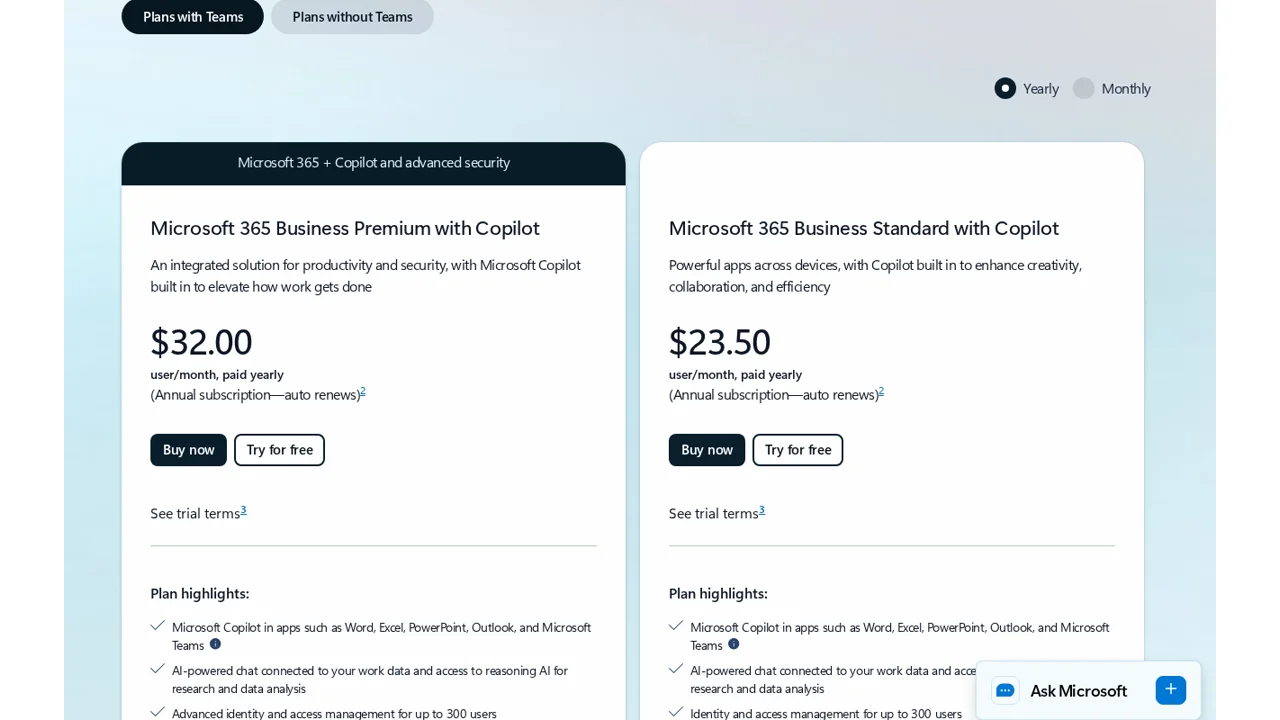
| Business Standard / Premium with Copilot | $23.50 and $32.00 per user/month billed yearly; $28.20 and $38.40 billed monthly | same |
Two credit mechanics matter more than the price of one credit. The first is pooling: credits sit at the tenant level, so a finance team and an engineering team draw from the same balance, and the guide's advice is to allocate credits per environment to stop one workload eating the rest. The second is what a credit buys. Microsoft breaks the cost of a task into four buckets — models (which model answered), runtime (managed orchestration, longer jobs cost more), context (how much of your mail, files and meetings the agent pulled in) and tools (the actions it took). Change the recipient list on an email and you have changed the price.
Why a meter is harder to budget than a seat
With seats you forecast headcount. With credits you forecast behaviour, which is the part of a team you cannot size in advance. Microsoft knows this: the guide ships two calculators (one for Cowork and the GitHub Copilot harness, one for Studio and business-application agents), and every table in it carries the same caveat — "these figures are rough planning estimates. Actual pricing will vary based on workflows and usage patterns."
There is also no published default cap. Microsoft's partner announcement says new Copilot Business licences bought through the Cloud Solution Provider channel will include a "preset monthly limit" from November 2, 2026, and then does not say what the limit is. If you are the person who has to approve this, that is the first question to put to your reseller, followed by which workloads are enabled to bill and where the spend policy lives in the Microsoft 365 admin center. All three are answerable before you turn anything on — which is the point. The order matters: spend policy first, agents second.
"Cowork, Code, and Autopilot, new long-running agentic capabilities, and frontier models like Astra and Fable all run on UBB."
Microsoft, Introducing the new Copilot with Home, Code and Autopilot, Sept 25, 2026
What Copilot users say when the billing model changes
The 143-point Hacker News thread on the reboot is mostly people arguing about the brand, but the useful comments are about the meter, because a large slice of that audience has already lived through one of these switches on GitHub Copilot.
gentlewater is the clearest case. The same tool, in their account, changed character the day it went to usage-based billing: "It was fantastic. Then it transitioned to abysmal over night when they switched to usage based billing. Now, if you put the same 50 USD towards GitHub copilot compared to Codex, I'm pretty sure Codex gives you 20x the usage or something." That is one person's comparison, not a benchmark, and it is about GitHub Copilot rather than the M365 product. It is also why this thread read the announcement as a warning: the tools did not get worse, the allowance got repriced.
The counter-example in the same thread is worth keeping, because it explains most of the disagreement about Copilot's quality. barney54 asked: "Does anyone have any good experiences with copilot? I have never heard anyone say anything good about it." epihelix answered with detail: "the current Enterprise version, with the poorly-named 'GPT 5.6 think deeper' option, is very decent indeed… Unlimited, free, high-quality, enterprise-protected inference." Then rmaxdev explained why both are true: "My experience was great because I had premium license and only used thinking models. Most colleagues didn't have premium and used default/auto model. People stick to their very first bad experience unfortunately." In other words, at a lot of companies the experience question is actually a licensing question — which model your seat routes you to — and that is now also a billing question.
The third recurring complaint is change fatigue, and it comes from the people who have to implement this. mugenjin23, who says they work in Australian local government, listed what the relaunch looks like from the admin seat: "most LG orgs are battling with the confusing of the current Enterprise Copilot conveluted-ness. This is just another change to deal with. What happens with Agents, Studio, Cowork and Scout? Is this a rebrand again of those?" A cost model that changes underneath a product that also changes names is a genuinely expensive thing to run, and none of the launch coverage priced that.
Adoption, meanwhile, is still small. Commenters quoting the Bloomberg piece put Copilot at just over 30 million paid subscriptions against an estimated 450 million business Microsoft 365 seats — about one in fifteen. That is the context for a metered model arriving now: it is a way to raise revenue per seat from an installed base that has been slow to buy the original product.
The consumer side, where the meter is not the problem
If you pay for Microsoft 365 for yourself rather than for a team, the interesting detail from the thread has nothing to do with credits. doubled112: "Microsoft allows you to subscribe to Microsoft 365 personal or family without AI for a small discount, but they hid the option on a page you can only get to if you click cancel on your subscription." misswaterfairy added that the Australian Competition and Consumer Commission is currently suing over that practice, and nsbdhciebsbdhc described the version of it they remember: prices raised at renewal with AI given as the reason, then a no-AI tier reintroduced at the old price, "effectively opting all users into the 'upgrade'". Take the last one as a user's recollection rather than a documented fact; the point stands either way. The cheapest way to stop paying for an AI assistant you did not ask for is to find the tier that does not include it, and that tier is not on the pricing page.
The other half of the story: the Copilot+ PC you already bought
The second thread from that weekend (102 points) is about the hardware spec that was supposed to make all of this local. If the Copilot+ brand is being retired, the NPU in those laptops loses its reason for being there. throwa356262 put the accounting bluntly: "The sad part of this is that all those powerful NPUs are basically paperweight. 35-50 low power TOPS taking 1/5 of the die area and not being used by anyone." donmcronald called the badge negative value on a machine he otherwise liked, because the related Windows services ran whether or not he used them, and advenn was still annoyed about the keyboard: a $5,000 workstation where the Copilot key replaced a Ctrl key. glimshe wrote the line that sums up the branding era: "This is the first time a corporation has spoiled a word for me."
The practical read is narrow and unglamorous: do not pay a premium for an NPU-marked laptop on the promise of Copilot features. Nothing about the September announcements suggests that promise is being kept.
Our read: who should act
Who should care, and who should not
- Don't buy (personal use). There is no consumer story here worth $18–25 a month. If you are on Microsoft 365 Personal or Family and the AI is unwanted, look for the no-AI tier and be aware it is offered inside the cancellation flow rather than on the pricing page.
- Do care (team leads, IT, finance). Before Code or Autopilot gets enabled on a tenant, get three answers in writing: what the preset monthly limit is on your licence, which workloads are allowed to bill, and where the spend policy is configured. Credits pool at tenant level, so the person who overspends is never the person who notices.
- Do care (if you already have Copilot and hate it). Check which model your licence routes you to before concluding the product is bad. Multiple commenters in the thread describe the premium thinking models as usable and the default "Auto" model as the reason colleagues gave up.
- Don't act on the announcement. Home and Code are still Frontier-programme rollouts and Autopilot is in private preview. There is nothing to migrate this week, and the pricing that lands in November is the part to plan for.
- Watch two dates. November 2, 2026: usage-based billing becomes the default for new Copilot Business licences through the partner channel. December 31, 2026: the promotional $18 year ends and Copilot Business returns to its $21 list price.
Sources
- Microsoft — Introducing the new Copilot with Home, Code and Autopilot (Sept 25, 2026)
- Microsoft — Copilot Credits Guide, September 2026 (PDF)
- Microsoft partner center — Usage-based billing is default on for new Microsoft 365 Copilot Business licenses starting November 2, 2026 (Sept 16, 2026)
- microsoft.com — Microsoft 365 Copilot pricing (read Sept 27, 2026)
- Reuters — Microsoft revamps Copilot with code generation, agentic AI tools (Sept 25, 2026)
- Hacker News — Microsoft abandons personal AI chatbot race with Copilot reboot (143 points, 245 comments)
- Hacker News — The Copilot+ PC brand is dead (102 points)
- Windows Central — The Copilot+ PC brand is dead