ElevenLabs Alternatives in 2026: What Long-Time Subscribers Actually Switch To
The short version: ElevenLabs is still the quality ceiling — its own paying users on HN say so, unprompted. But its cheapest tier with professional voice cloning is Creator at $22/mo, while Cartesia sells a developer tier at $5/mo and Kokoro costs $0 and runs on your own CPU. The real story is what kind of job you have: pro voice clones and dubbing stay expensive for a reason; bulk narration is already a solved, free problem. And if you are shopping for “open-source TTS”, read the license twice — two of the most-upvoted projects are not as open as their READMEs suggest.
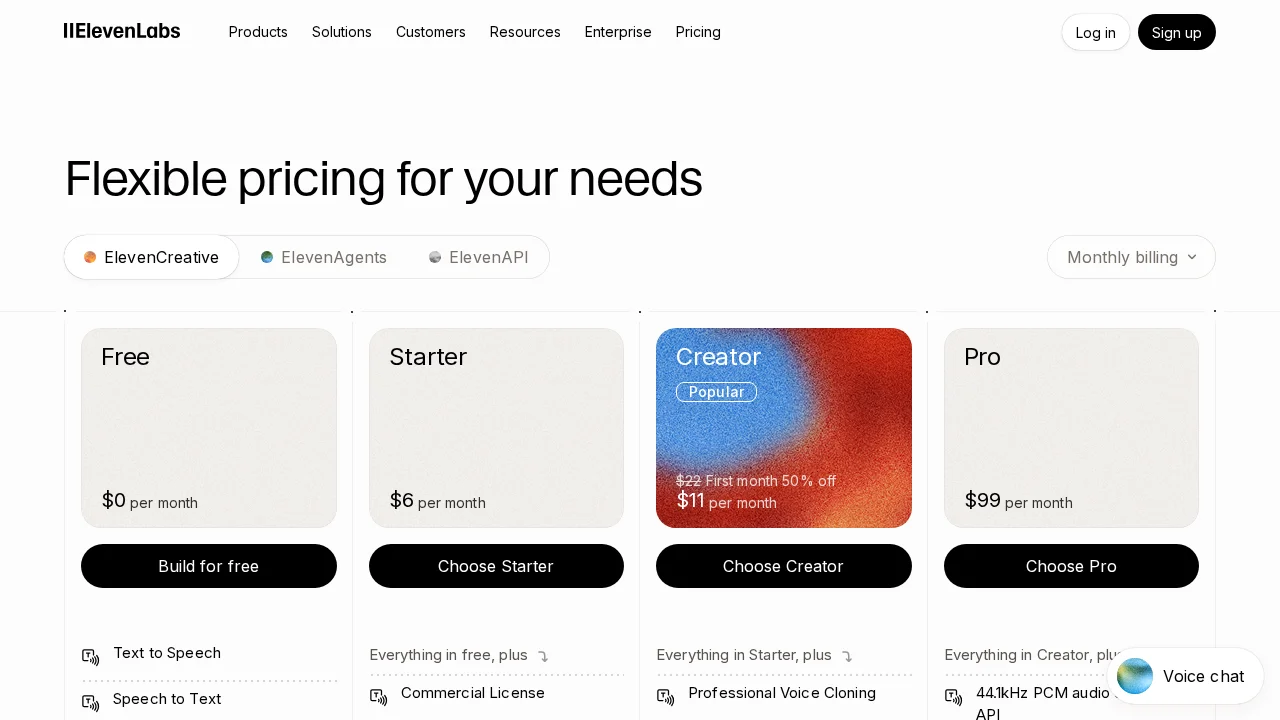
ElevenLabs’ own pricing page, September 2026: the wall is between Starter ($6) and Creator ($22), because that is where cloning starts.
Q: What does ElevenLabs cost in 2026?
Read off their pricing page today (2026-09-22). Note the shape of it: the free tier is generous enough to evaluate, the $6 tier is mostly a credit bump, and the feature people actually come for — professional voice cloning — starts at $22/mo.
| Plan | Price | Credits / mo | What changes |
|---|---|---|---|
| Free | $0 | 10k | TTS, STT, sound effects, voice design, music, 3 Studio projects |
| Starter | $6 | 30k | 20 Studio projects |
| Creator | $22 (first month $11) | 121k | Professional Voice Cloning, more credits |
| Pro | $99 | 600k | Higher throughput |
| Scale | $299 | 1.8M | 3 professional voice clones |
| Business | $990 | 6M | 10 professional voice clones, managed dubbing |
Q: What do people who pay ElevenLabs say about the free stuff?
This is the useful part, because it comes from subscribers rather than people who tried the free tier once. In the July 2026 Kokoro thread (515 points), the top comments were practitioners, and the pattern was consistent: Kokoro is enough until you need ElevenLabs’ larger professional voices.
“I used Kokoro pretty extensively with an app I was developing over the last year and it’s been excellent, both on- and off- GPU. Even with Elevenlabs (long time subscriber) the comparative quality of Kokoro keeps up really well until you get to their larger models with their professional voices.”
“The voices are better than the cloud provider IMO. I’m using it in an open source tool I built for listening to coding agents instead of watching them work, and it’s been great. Local, private…”
The same thread has the sentence that actually summarizes the whole market — an open-weight 82M model being compared to paid cloud APIs:
“It’s tough to name the best local TTS since they all seem to trade off on quality and features and none of them are as good as ElevenLabs’ closed-source offering. However Kokoro-82M is an absolute triumph in the small model space. It curbstomps models 10-20x its size in terms of quality while also being runnable on like, a Raspberry Pi.”
Q: Is Kokoro really free, and what’s the catch?
Free, open-weight, and unusually light: one commenter ran it for an accessibility product specifically because it does not need an Nvidia GPU, and valued that it accepts manual IPA pronunciation for names and homographs (sudobash1, HN). Another built a personal podcast pipeline on a GTX 1650: clean text, generate audio, serve the result as an RSS feed for the morning drive (bronco21016, HN).
The catches are real but specific: no SSML (“I do wish there were better support for SSML” — rnxrx), you supply the hardware, and you are trading away the professional voice-clone tier that is ElevenLabs’ moat. If your job is “read 40 blog posts to me”, none of that matters. If your job is “sound exactly like this actor, at 200ms latency, in 30 languages”, it does.
Q: “Open-source TTS” — which ones are actually open?
This is where people get burned. Chatterbox hit 670 points in June 2025 and is widely cited as the open ElevenLabs alternative. One commenter went to the repo and quoted the maintainers directly:
“For now, that means we’re not releasing the training code, and fine-tuning will be something we support through our paid API.” … “this is just ~3/10 open, or not really open at all” … “this repo is like a version of Linux that you can’t cross-compile or port.”
The lesson generalizes: weights are not the project. Before you build on any of these, check three boxes — can I fine-tune it, can I redistribute it, and does the license cover commercial use. Community models that pass that test are worth the setup cost; ones that fail it are a hosted API with extra steps. The other failure mode is hardware: VibeVoice (448 points) is genuinely open and genuinely heavy — one user measured 832 seconds to generate a 66-second clip on CPU (TheAceOfHearts, HN), which is what pushes “GPU-poor” users back to Kokoro.
Q: What about the fine print on uploads?
Worth 60 seconds if you run a business. On the ElevenLabs Music v2.5 launch thread (September 2026, 67 points), a commenter quoted the terms of service rather than arguing about music:
“Note that ElevenLabs claims the right to train on any data you upload to the service, such as editing a song you made … ‘(d) License to Your Content and NILV. You hereby grant to ElevenLabs a license to use, reproduce, modify, adapt, publish, translate, create derivative works from…’”
Whether that matters is a legal question, not a vibe, and it is the kind of clause to read before you upload client audio — the same discipline applies to any voice API.
The switching test
Stay on ElevenLabs if:
You need professional voice clones of a specific person, dubbing, music, or a low-latency streaming API for a customer-facing voice agent. It is the reference implementation every other vendor benchmarks against, and their own subscribers admit the gap is at exactly that tier.
Switch to Cartesia ($5/mo) if:
You are a developer shipping a voice feature. Their Pro tier costs $5 for 100K credits including a commercial-use license and instant voice cloning — a third of ElevenLabs’ Creator tier. One HN commenter who builds video pipelines with Cartesia Sonic says the number that matters is not raw speed but “consistent emotional delivery across like 50+ scenes without it drifting”, and that mid-sentence pauses and word emphasis are “where most open source TTS falls apart” (tcbrah, HN). Read that as the bar for any free tier you are considering for client-facing work.
Switch to Kokoro ($0) if:
Your job is bulk narration — audiobooks, article readers, podcast filler, spoken agent notifications — and you have any machine from the last five years. Expect to lose SSML niceties and the pro-voice tier, and to own your own uptime.
Don’t switch if:
You are on the free tiers of both. 10k ElevenLabs credits or a local Kokoro install cost the same thing: nothing. Switching only pays when you are paying.
Be careful if:
Your use case depends on cloning a voice you do not own. Consent rules are on you, not the provider, and none of the pricing above changes that.
Wispr Flow alternatives → AI meeting notes → Free LLM APIs →
Method: ElevenLabs and Cartesia pricing read from their own pricing pages on 2026-09-22; quotes verbatim from HN threads on Kokoro (515 pts, Jul 2026), VibeVoice (448 pts, Sep 2025), Chatterbox (670 pts, Jun 2025) and ElevenLabs Music v2.5 (Sep 2026), with links. No vendor paid for this page. Kokoro is an open-weight model you run yourself — we don’t resell it.