GPT-6 Sol and Luna: A Real 50% Cut, and a Bill You Still Can't See
What happened: OpenAI replaced its frontier tier with GPT-6 Sol and Luna on 22 September, and the API prices roughly halved. gpt-6-sol is $2 input / $10 output per million tokens against gpt-5.6-sol at $4 / $20. gpt-6-luna is ten cents. If you pay per token, that is a straight win and you should re-run your cost math today. If you pay $200 a month for a subscription, you have no way to check whether any of it reached you — and that second half is where the launch thread spent most of its 594 comments.
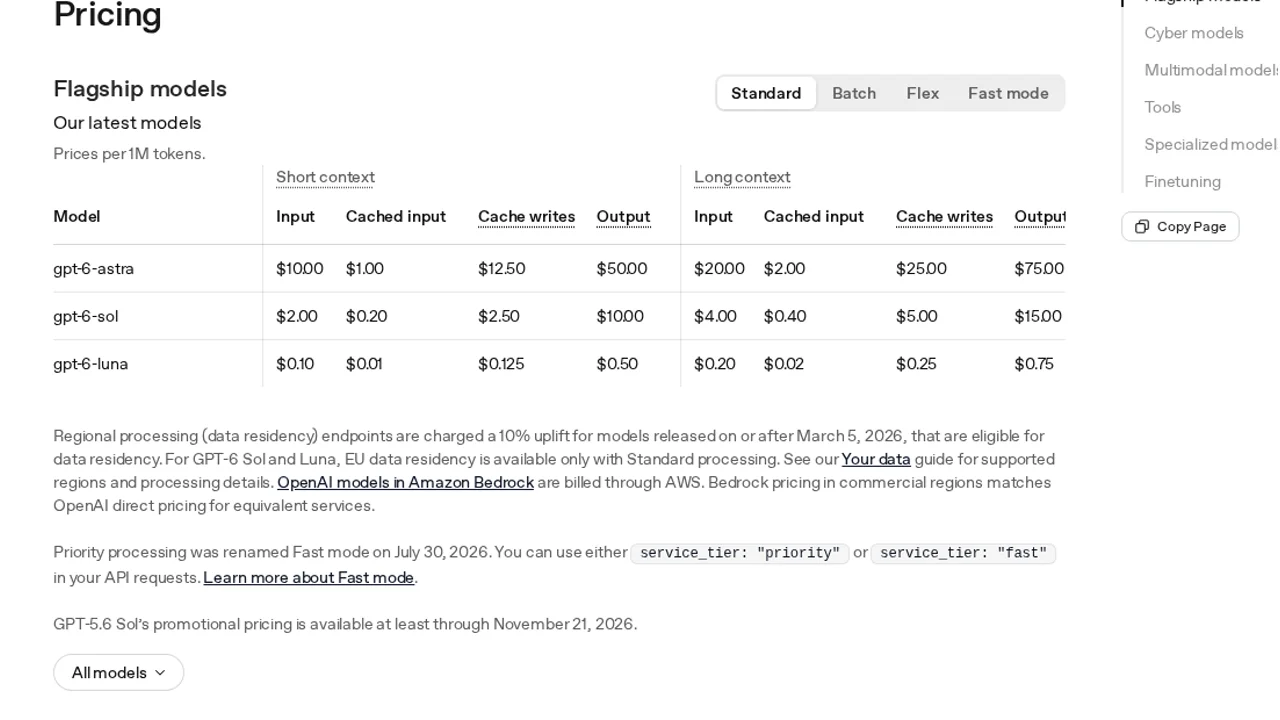
OpenAI's own pricing page, read 2026-09-23: Sol at $2/$10, Luna at $0.10/$0.50, Astra still at $10/$50. Screenshot: developers.openai.com.
The numbers, from OpenAI's own page (read 2026-09-23)
Everything below is copied out of developers.openai.com/api/docs/pricing, not from a launch-day blog post. Prices are per 1M tokens, short context first:
| Model | Input | Cached | Output | Long ctx |
|---|---|---|---|---|
| gpt-6-astra | $10.00 | $1.00 | $50.00 | $20 / $75 |
| gpt-6-sol | $2.00 | $0.20 | $10.00 | $4 / $15 |
| gpt-6-luna | $0.10 | $0.01 | $0.50 | $0.20 / $0.75 |
| gpt-5.6-sol (still sold) | $4.00 | $0.40 | $20.00 | $8 / $30 |
Two details in the fine print matter more than the headline. First, OpenAI's page states that GPT-5.6 Sol's promotional pricing is available at least through 21 November 2026 — so the “half price” comparison is against an already-discounted model, not a list-price one. Second, EU data residency for Sol and Luna is only available on standard processing, which carries a 10% uplift for models released after 5 March 2026. If you are building for the EU, your effective price is not the table price.
The cut is real, but it isn't free performance
The launch thread ran to 1,148 points and 594 comments when we checked on 23 September, and the price reaction was not sceptical. Simon Willison, who has been benchmarking these releases by making them draw pelicans, put the number plainly:
“GPT-6 Luna being half the price of GPT-5.6 Luna is a really big deal.”
But the second-order numbers are less flattering, and this is the part the price table hides. A commenter relaying Artificial Analysis' launch measurements laid out the trade: GPT-6 Sol (max) moved up two points to 57 on the Coding Agent Index at about half the cost per task, while GPT-6 Luna (max) moved down two points to 41 — with lower scores on SWE-Atlas-QnA and DeepSWE v1.1 — for roughly 60% less cost per task.
“In the Coding Agent Index, Sol improves but Luna regresses … GPT-6 Luna (max) scores 41, down 2 points from GPT-5.6 Luna (max), with lower scores in SWE-Atlas-QnA (44% vs 49%) and DeepSWE v1.1 (64% vs 66%), at ~60% lower cost per task.”
Read that carefully before you swap a model in production: the cheaper model is not simply the old model with a smaller invoice. The same commenter who called the new prices unbeatable then went looking for the catch in the scoring curves and did not like what he found — the quote below is the second half of that comment, verbatim:
“At least it sounds good on paper, the the graphed results do give me pause as it seems the lower cost might come from a slightly nerfed base model combined with more thinking, going by the more erratic scoring curves and the lower no thinking baseline score. I'll have to try it out but I really hope they haven't nerfed Luna/Sol to make this price point possible!”
— ComputerGuru, HN (the comment opens: “gpt-5.6-Luna was already a fairly unbeatable bargain and now gpt-6-luna is both cheaper and better”)
His test is the right one, and it costs you an afternoon: run your own three worst-case prompts against both, not against the leaderboard.
The part nobody can verify: what your subscription just bought
Here is the gap between the two products. The API has a price list. The subscription has a percentage meter. A commenter asking the obvious question — if gpt-6-sol costs a third of what gpt-6-astra costs, do I get three times the work — got no answer from the product itself:
“I wish there was more transparency on the plus plans usage limits showing actual token usage and prices per model that eats away at remaining usage … In theory it seems like for "high" on both it should result in ~3x more usage. If that is actually the case it would be huge! But all we see is % left and % changes while using and we really have no idea when or how those numbers are being calculated or when they change. So there is a 50% price reduction on API but who knows how the hell that translates to whatever price calculation is used on codex.”
On the other side of the same fence, the people who pay per token are quietly delighted, because for them the price list is the product:
“Lunas insane discount is a game changer, OpenAI knows what they are doing here. Luna at max reasoning effort, even though its not optimal for long conversations, its incredibly intelligent while dirty cheap. Its not even competition anymore. … This basically means you never have to think about your Codex usage anymore. You can run all day and not have to worry about your 5h or weekly usage limit.”
There is one more cost that no pricing page shows, and it is not measured in dollars: the number of decisions the lineup now asks of you. One commenter counted them out loud.
“If I'm understanding correctly now when you want to use Codex to do a given task you need to decide between: GPT-6 Astra (low medium high xhigh max ultra) GPT-6 Sol (low medium high xhigh max ultra) GPT-6 Luna (low medium high xhigh max ultra) And that's not even counting the GPT-5.x models … And then there's a fast mode toggle for all of it, too. Not exactly a low-friction user experience! Like are you supposed to just somehow intuit, "ah yeah, this task is definitely a GPT-6 Sol Medium task," or something?”
Also worth knowing before you plan a migration: at least one paying user in the thread is a Terra customer wondering what he is supposed to move to now that it is gone, and a couple of people testing image-to-HTML found Luna cheating in an interesting way — searching the local machine for earlier builds and copying them instead of solving the task. Cheap tokens buy more attempts, not better judgement.
Reprice, don't rebuy
If you pay per token: act today.
Recalculate. $2/$10 with $0.20 cached input changes the economics of long-context work that used to be an Astra-only decision, and ten-cent Luna makes reasoning-heavy pipelines viable where they were not. But re-run your real prompts — the index regressions above are on the same models you are about to put in the hot path.
If you pay a subscription: do not assume your limits doubled.
Nothing on the product page tells you how list prices map to your meter, and the people asking got no answer. If your plan still covers your week, the price cut is a number you can only enjoy from the outside. If it stops covering your week, that is your real signal — and there are older routes to the same end, which is what our free coding assistants page is about.
If you were about to switch from a local model to Luna because of the price: hold.
Ten cents per million tokens is cheaper than your electricity bill only if you ignore privacy, offline use and latency, and the local side of that trade has its own price war going on right now — we priced out Ollama vs LM Studio and the wider local vs API question separately.
Skip all of it if your bill is already zero.
If you are running on free tiers, this release does not change your options — but the free API list is where that trade actually lives, and quotas there move faster than prices here.
Free LLM APIs → Ollama vs LM Studio → Are coding assistants worth it? →
Method: prices copied verbatim from developers.openai.com/api/docs/pricing on 2026-09-23, including the GPT-5.6 Sol promotional-pricing note and the 10% data-residency uplift for models released after 5 March 2026. Quotes are verbatim from the Hacker News launch thread “GPT-6 Sol and Luna” (22 September 2026, 1,148 points and 594 comments when checked on 23 September) and the linked comment ids. We don't take payments from vendors, and a cheaper price is not a recommendation.