ChatGPT vs Claude: the "5x value" study is good work measuring the wrong thing
On October 5, SemiAnalysis published a measurement of every major AI subscription and concluded that a Claude plan carries about five times the API-equivalent value of a ChatGPT plan at the same price. The measurement is careful, the methodology is public, and the sentence that follows it in the same article — that the study has no reliable data on token efficiency — is the one that decides whether you should act. Short version: if you are a heavy agentic coder on a $200 ChatGPT plan, the case to trial Claude this month is real. If you are anybody else, this study does not tell you what to buy, and two numbers in it matter far more than the headline.
The short version
- What was measured: how far each plan's usage meter moves per token of input, output, cache write and cache read, then those tokens priced at the vendor's own API rates.
- The headline: at the mid tier — Opus 5.5 against GPT-6.1 Sol — Claude comes out roughly 5x. SemiAnalysis also calls the same gap "~4x higher API-equivalent value" further down when weighing OpenAI's counter-argument.
- What it does not measure: how many tokens a model burns to finish your task. SemiAnalysis says the industry has no reliable data for that and that it distrusts the benchmark people cite instead.
- The dated fact to act on: OpenAI's own cut to the $200 plan keeps old limits only until October 29, 2026 for plans bought before it.
- Bottom line: do not switch plans because a dollar-per-token figure moved. Switch if you are hitting walls on agentic coding, and switch by trialling, not by spreadsheet.
What the study actually did
The problem with AI subscriptions is that nobody publishes the allowance. You get a 0–100% meter over five-hour and seven-day windows, and no table of what a token costs against it. So SemiAnalysis worked backwards. It ran experiments that maximise one token type at a time — fresh input, cache writes, cache reads, generated output — watched how far the provider's meter moved, and repeated runs until the measurement range sat within ±5%. Cache reads mattered enough to isolate: on some plans 500 million cached tokens do not move the meter at all, which the study treats as free.
Then it applied its own agentic usage ratios from September, calculated how many tokens fit inside each plan's window limits, and priced that volume at the vendor's public API list. That last step is where the metric gets its name and its weakness: an "API-equivalent value" is what your allowance would cost if you bought those same tokens through the API instead.
Two structural findings came out of it that are more useful than the ranking. First, none of these plans expose token limits, so the meter is the only disclosure you get, and the labs can move it whenever they want by adjusting what a token costs internally. Second, the study caught exactly that happening: one of three identical subscriptions it tested showed roughly 20% lower limits than the other two, and the provider's explanation was that the unlucky account sat in an "extremely tiny" A/B test about how to balance when people hit limits. Nothing malicious proved, and a useful fact established anyway — limits can change under you without a changelog.
The numbers, and the 2x hiding inside them
For the top-of-range models, the allowances are closer than the headline implies. A $200 Claude plan that has used $2,485 worth of Fable 5.1 still has half its limit left (Fable is capped at 50% of the weekly allowance); the comparable ChatGPT plan is exhausted at $2,897 of Astra. Call that a wash, and note that the study is describing agentic workloads specifically, not chatting.
The 5x appears one tier down, where both companies put the model they expect you to use daily. Opus 5.5 against GPT-6.1 Sol, same $200 class of plan: about five times the API-equivalent value, with the study's own fallback figure of roughly 4x when it considers that ChatGPT plans have no five-hour window and are therefore easier to drain.
Here is the part the headline skips. At standard API rates on October 7, Opus 5.5 was listed at $4 per million input tokens, $20 output and $0.20 for cache reads, while GPT-6.1 Sol was $2, $10 and $0.10. Opus costs exactly twice as much per token on every line. So even if both subscriptions handed you the same number of tokens, the Claude plan's tokens would convert into twice the dollar value. Some of the 5x is the price list, not generosity, and the study half-says so itself when it concedes that comparing tokens costs OpenAI the argument anyway.
Anthropic is also getting paid from a different pocket on those plans: its own pricing page lists "$100 to $200/month in API credits" as part of Max, which is a very different thing from usage inside the app.
| Plan class | Monthly | What the vendor says | Source |
|---|---|---|---|
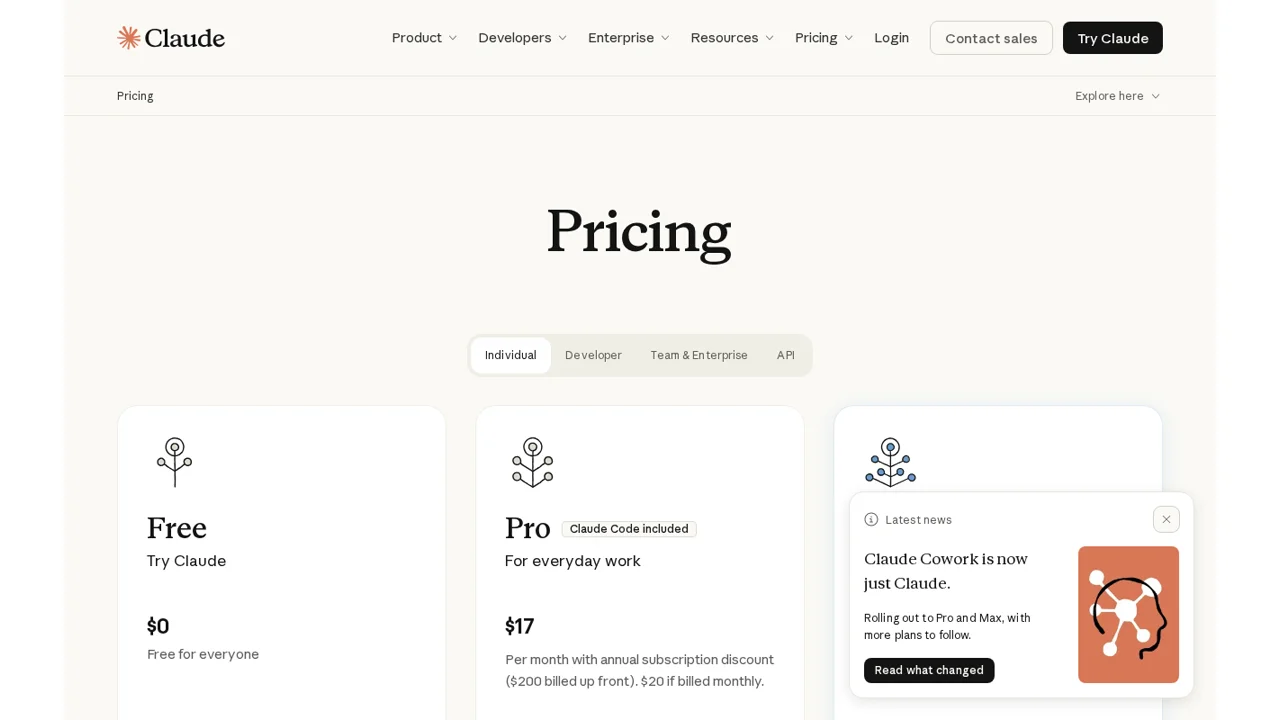
| Claude Pro | $17 annual / $20 monthly | $200 billed up front on annual; Claude Code and Claude Cowork included | claude.com, Oct 12 |
| Claude Max 5x | $100 | 5x the Pro usage allowance, plus $100–$200/month in API credits | claude.com, Oct 12 |
| Claude Max 20x | $200 | 20x the Pro usage allowance, priority access at peak | claude.com, Oct 12 |
| ChatGPT Plus | $20 | Comparable per-dollar value to the Pro tiers for Sol-class models, worse on Astra | SemiAnalysis, Oct 5 |
| ChatGPT Pro 100 / 200 | $100 / $200 | The $200 plan's allowance was halved; all Pro tiers now give the same tokens per dollar | SemiAnalysis, Oct 5 |
| ChatGPT Pro 500 | $500 | 21% more Astra than the old $200 plan; the headline feature is the 300 tokens/second speed tier | SemiAnalysis, Oct 5 + OpenAI DevDay recap |
Notice the shape of OpenAI's change: it did not just cut a tier, it flattened the ladder. Pro 100, Pro 200 and Pro 500 now return the same value per dollar, where the old Pro 200 was roughly twice as good per dollar as Pro 100, which was about twice Plus. Anthropic's tiers were already flat in per-dollar terms. That has a concrete consequence for anyone thinking of upgrading "because the bigger plan is better value": on both vendors, it is not. You buy the tier that matches your usage and no better.
The backlash is partly right, and it is about tokens
The Hacker News thread on the study ran to 94 comments, and the strongest objection is not that the methodology is wrong but that the metric is not the thing people buy. A commenter making the case for "usage" over "value":
"This says 'Anthropic gives you 5× more API-priced model usage', which is not equivalent to 'Anthropic is 5x as much value'. This does not take into account model/harness efficiency. I tried looking up some benchmarks and Claude seemingly uses roughly 5x as many tokens while taking its sweet time to complete a task."
throwuxiytayq, Hacker News
SemiAnalysis pre-empts that one, and not convincingly: it acknowledges token efficiency is "extremely relevant", says the industry lacks reliable data, and dismisses the benchmark most people cite as unrepresentative of real work. Fair enough as a caveat. It is also the admission that the study cannot answer "which plan finishes more of my work", which is the question a subscriber has. Separately, Anthropic's own pricing documentation notes that the tokenizer it adopted from Claude 4.7 onward splits the same text into about 30% more tokens on average than before, so token counts are not portable between these vendors in the first place.
A second commenter redid the arithmetic from the other direction, counting the bonus resets that both labs hand out:
"The title is misleading: by token count, it's only 3× more valuable. And there's also a major error in the calculation: it doesn't account for the 'generous' resets that are mentioned at the beginning of the article! Taking the 1 to 2 weekly resets into account and comparing tokens, the ChatGPT Pro 200 plan works out to be between 1.2× and 1.7× more cost-effective per token than Claude's for Astra."
xzjis, Hacker News
Resets are the wildcard nobody can price honestly, and the study takes the defensible position that discretionary extras should be excluded. One commenter put the counter-position better than we could: "I want a predictable LLM inference subscription, not a gacha game."
Two other threads of criticism are worth naming. One is that the price list flatters Anthropic — "Anthropic has way more inflated api token priced than OpenAI what is plainly visible on cost charts" — which is the same 2x we described above, viewed uncharitably. The other is a conflict-of-interest claim about a personal connection between the newsletter's author and Anthropic staff. We cannot verify that and SemiAnalysis does not disclose any such relationship; treat it as an allegation from the thread, not a fact.
And the reason all of this lands: subscription limits are not the bottleneck for a large share of paying users. Two subscribers with both tools said as much — one hasn't come close to hitting limits since Opus 5.5 and GPT-Sol 6.1 arrived, another says "GPT 6.1 Sol feels virtually unlimited to me atm". A third went the other way and said 6.1 Sol's slower pace is the only reason he hits walls later than before. That disagreement is the real state of this market. It depends on your workload, your harness and your model choice, none of which a per-dollar table can see.
What the subscription money is actually buying
The study's numbers on Anthropic's own economics are the least quoted and most clarifying part. Subscriptions are about 10% of the company's revenue but absorb over 40% of inference compute, and drag blended revenue per megawatt by roughly $36 million in the study's model. At full utilisation, a user who maxes Opus 5.5 lands at a −369% gross margin; one who maxes Fable 5.1 lands at 1%. At a more realistic 20% utilisation those become 6% and 80%. Read that as the shape of every plan in this category: whoever uses the expensive model continuously is being subsidised, and whoever pays and forgets is funding them. It also explains both vendors' behaviour this year — Anthropic quietly lowering the API-equivalent value of its most premium models rather than the nominal allowance, and OpenAI cutting the $200 tier outright and adding a $500 one with a speed tier as the headline.
Who should switch, who should not
- Heavy agentic coder, hammering a ChatGPT Pro plan, hitting the weekly wall: worth a month on Claude Max 5x at $100. The 5x is not the reason. The reason is that Claude plans carry a five-hour window and Opus 5.5 is the model this class of work is being done on.
- On a pre-cut ChatGPT Pro 200 plan: know your own deadline. Those higher limits run to October 29, 2026, and nothing after that is grandfathered. Decide before it, not after.
- Paying $20 and never hitting a limit: change nothing. There is no plan on this table that improves your week, and both vendors price every tier the same per dollar now.
- Using ChatGPT's own harness — Codex in the cloud, Plugins, the always-on agents: slower to switch than the table suggests. The value metric prices tokens, not your workflow, and a cheaper token you have to rebuild your habits around is not cheaper.
- Thinking of upgrading a tier for better value: don't. On both vendors the per-dollar value is flat across tiers. Buy the smallest allowance that does not interrupt you.
- Wanting the honest answer to "which is better": rent both for one month on the work you actually do, then cancel one. That costs less than a single unstructured migration.
What we could not verify
- OpenAI's current tier list. Its pricing page refused to load from this server on October 12 (and, earlier, showed an error page), so every ChatGPT price and allowance quoted here comes from SemiAnalysis or OpenAI's own DevDay recap, and is labelled as such rather than presented as read off the vendor page.
- The live meter. The study's original data sits behind its paid dashboard. We are reporting its published figures, not re-measuring them.
- Token efficiency. Nobody credible has published it, including the authors of the study, and it is the difference between a 5x value gap and a real productivity gap. If someone does publish it, the ranking in this article should be re-read.
- The conflict-of-interest claim. Thread allegation, unverifiable by us, and not something we will state as fact.
Sources
- SemiAnalysis — Anthropic Subscriptions Offer 5x+ More Value Than OpenAI (Oct 5, 2026)
- Hacker News discussion — 82 points, 94 comments (Oct 6, 2026)
- XenoSpectrum — SemiAnalysis: Claude's $200 plan offers about 5x the API-equivalent value (Oct 7, 2026)
- Anthropic — Claude pricing (read Oct 12, 2026) · Anthropic — What is the Max plan?
- OpenAI — DevDay 2026 recap (Sept 29, 2026)
- Quote links: throwuxiytayq · xzjis · scotty79 · chilmers · Bigsy